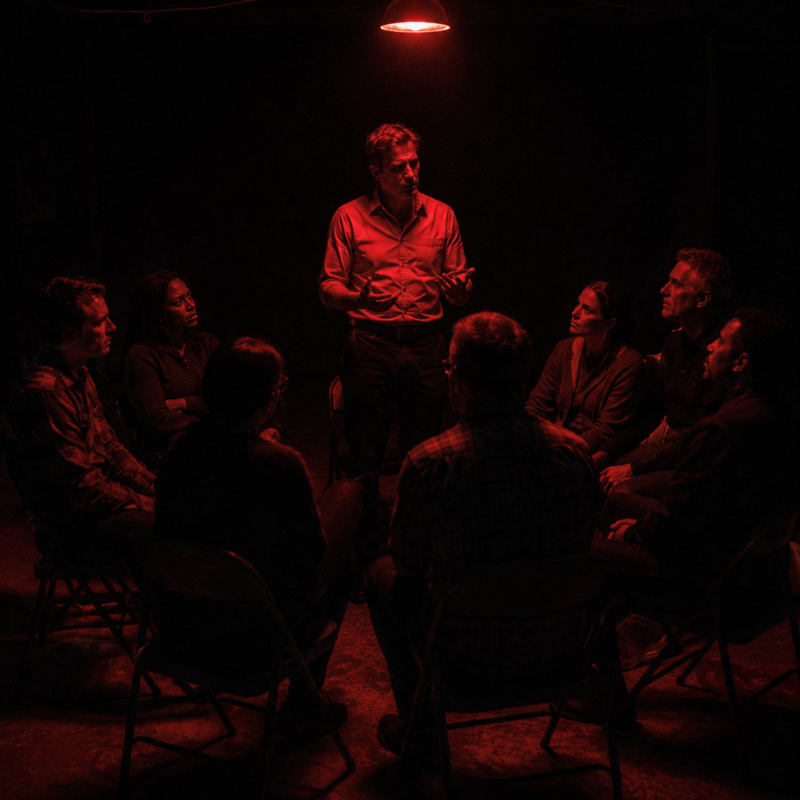
In August 1971, two dozen college students were sorted by coin flip into guards and prisoners and locked in a fake jail in a Stanford basement. Within days the guards turned cruel, the prisoners fell apart, and the study was called off after six. The Stanford Prison Experiment became one of the most famous things science has ever said about human nature: put good people in a bad system, and the system wins. There’s just one problem. It didn’t happen the way you were taught.
The guards didn’t discover cruelty. They were handed a script.
The short version
- In 1971, Philip Zimbardo ran a mock prison; the guards grew abusive within days and he stopped it after six.
- The textbook lesson — situations turn ordinary people cruel — rests on a study that was never a controlled experiment.
- Archives show the guards were coached to be harsh, and the famous “breakdown” prisoner later said he was largely acting.
- When researchers ran it properly in 2006, the tyranny didn’t appear. The story is stronger than the science.
What the Textbook Says Happened
The official version, from Haney, Banks and Zimbardo’s 1973 write-up, is tidy and alarming. Randomly assign normal young men to be guards or prisoners, give the guards uniforms and mirrored sunglasses, and the roles take over. Guards invented humiliations; prisoners rebelled, then broke; one, prisoner 8612, melted down so badly he had to be released on the first night. Zimbardo pulled the plug after six of the planned fourteen days. The conclusion was that the situation, not the person, did it — and that framing became a load-bearing wall in psychology, wheeled out to explain everything from Abu Ghraib to genocide.
The Guards Were Coached
Then the archive opened. In 2019, the historian Thibault Le Texier went through Zimbardo’s own recordings and papers and published what he found in American Psychologist. The guards didn’t drift into cruelty on their own. Before the study they were briefed to be tough, to create fear, to strip the prisoners of individuality, and the warden — a student named David Jaffe — handed them specific tactics. Once it began, staff egged on the harsh guards and leaned on the gentle ones for not playing along. Zimbardo wasn’t a neutral scientist observing an experiment. He was the prison superintendent, directing the outcome he would later report as a discovery.
The Famous Breakdown Was Partly a Performance
The most cinematic moment — prisoner 8612 screaming that he was burning up inside — has a second act the textbooks skip. The man behind it, Douglas Korpi, later said the meltdown was largely an act. He wanted out, partly to study for a graduate exam, was wrongly told he couldn’t simply leave, and performed distress to force the issue. The most sadistic guard, nicknamed “John Wayne,” has said much the same about himself: he was consciously playing a character he believed the experimenters wanted. People weren’t dissolving into their roles. Some were auditioning for them.
It Was Never Really an Experiment
Strip away the drama and the method is thin: twenty-four hand-picked students, no control group, and a lead researcher running the prison from the inside. It was never published as an experiment in a peer-reviewed empirical journal; it was a demonstration built to reach a conclusion its author had largely settled in advance. And when Alex Haslam and Stephen Reicher restaged it under controlled conditions for the 2006 BBC Prison Study, the magic didn’t happen. Guards didn’t automatically turn tyrannical; prisoners didn’t meekly submit. Tyranny, it turned out, needs more than a uniform.
Why It Refuses to Die
So why is a debunked study still on the syllabus? Partly because the lesson is oddly comforting: if the situation does everything, no individual is really to blame. It’s the same seductive logic that clings to the Milgram experiment. But it gets the real danger backwards. Systems that produce cruelty don’t run themselves; they’re built, staffed, and directed by people making choices — which is exactly what happens inside the groups that manufacture obedience for real, or in the deliberate control machinery of a case like NXIVM.
What This Doesn’t Mean
None of this says situations don’t matter. They do, enormously; uniforms, authority, and permission genuinely shift behaviour, and there is decades of better research showing it. What the Stanford Prison Experiment can’t support is the strong version everyone quotes — that role and setting alone will reliably turn ordinary people into monsters with no direction required. That claim was staged. The more honest lesson is quieter and more useful: cruelty usually has an author, and the author is rarely just “the situation.”
Frequently Asked Questions
Was the Stanford Prison Experiment real?
It happened — Philip Zimbardo ran a mock prison at Stanford in 1971 — but it was never a controlled experiment. There was no control group, the sample was tiny, and Zimbardo ran the prison himself. Archive research published in 2019 showed the guards were coached to be cruel rather than turning cruel on their own.
Did the guards become sadistic on their own?
Largely no. Thibault Le Texier’s 2019 review of Zimbardo’s archives found the guards were briefed and encouraged to be harsh, and lenient guards were pressured to toughen up. The idea that the role by itself produced the cruelty isn’t supported by the records.
Does it prove situations turn good people evil?
Not in the strong form it’s famous for. Situations clearly shape behaviour, but a 2006 controlled restaging, the BBC Prison Study, found participants did not automatically become tyrannical. The dramatic “the roles take over by themselves” claim was staged, not discovered.
Sources
- Le Texier, T. (2019). Debunking the Stanford Prison Experiment. American Psychologist, 74(7), 823–839. Retrieved 19 July 2026.
- Haney, C., Banks, C. & Zimbardo, P. (1973). Interpersonal dynamics in a simulated prison. International Journal of Criminology and Penology, 1, 69–97.
- Reicher, S. & Haslam, S. A. (2006). Rethinking the psychology of tyranny: The BBC prison study. British Journal of Social Psychology, 45(1), 1–40. Retrieved 19 July 2026.