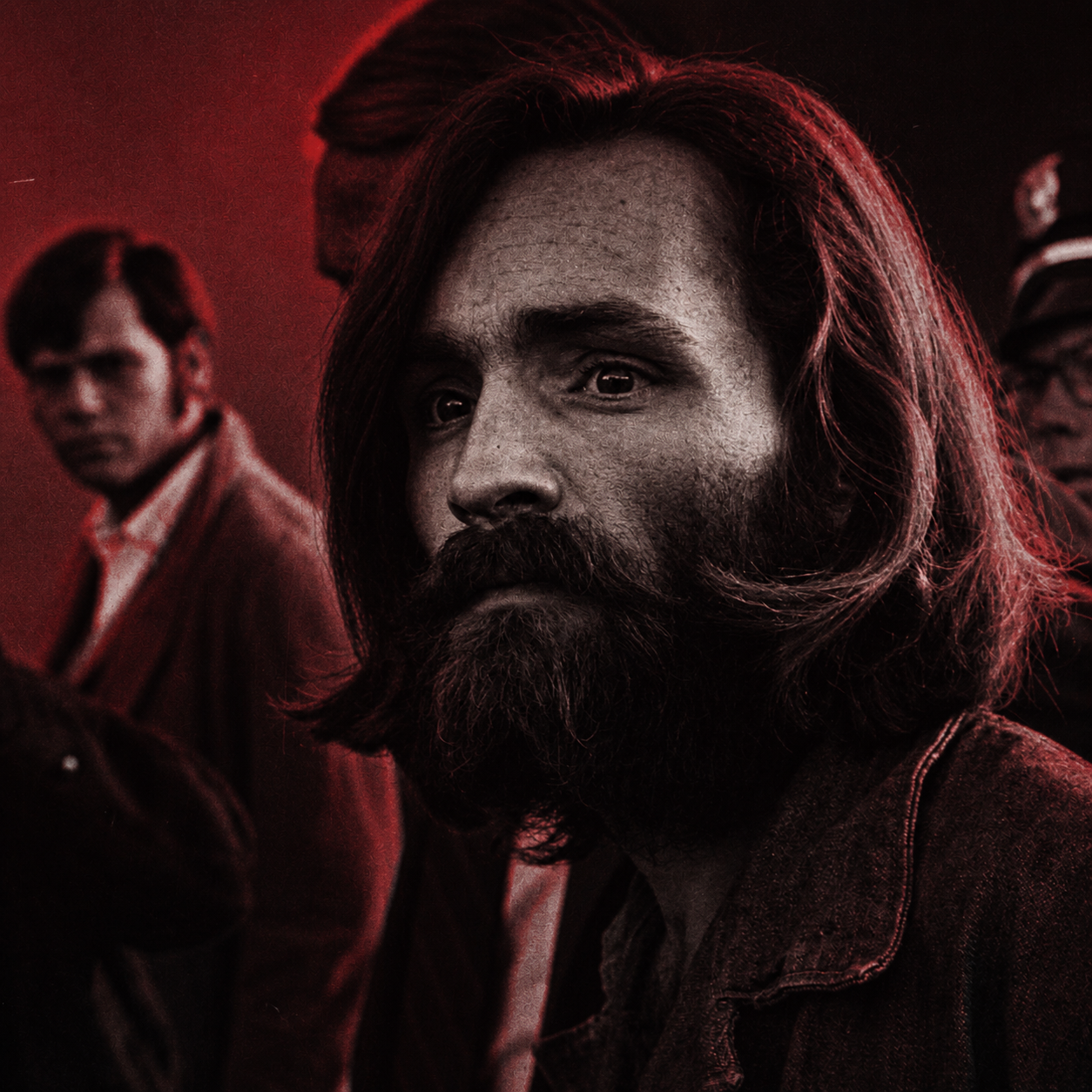
Manson manipulation tactics are mostly discussed using material Charles Manson made up about himself. The story that his mother sold him for a pitcher of beer is the best known. Jeff Guinn went through the records for his 2013 biography and was asked whether it was true. His answer: never, never, never.
The most successful thing Manson ever manipulated was his own reputation, and it is still working.
The short version
- The pitcher-of-beer story came from Manson. The records do not support it.
- His philosophy was Dale Carnegie, Haight-Ashbury patter and Beatles lyrics.
- Even the motive, a race war, was the prosecution’s theory and is disputed.
- What is documented is duller and worse: he gave orders, and people obeyed.
The Biography Is Largely His Own Work
Start with what can be checked. Britannica records Charles Milles Manson born in Cincinnati on 12 November 1934 to a 16-year-old named Ada Kathleen Maddox. In 1939 Maddox and her brother robbed a man and both went to prison; Manson went to relatives in West Virginia. By 1947 his mother had tried to place him in foster care; in 1948 he robbed a grocery store.
That is a documented childhood of neglect and institutions. It is not the one in the legend.
Guinn’s Manson: The Life and Times of Charles Manson went back to the birth records. The pitcher-of-beer detail did not survive them. Neither did the claim that his mother was a prostitute — Guinn found no evidence for it beyond Manson’s own statements, and those usually turn out to be lies.
Manson told the story for decades. As Guinn put it, nobody ever called Charlie on any of it.
The Philosophy Was Assembled From Paperbacks
The image of Manson as an originator is the part that flatters him most.
Guinn’s account, given to Kirkus Reviews, is deflating and specific: Manson lifted Dale Carnegie, adjusted it with mumbo jumbo he picked up on the corners of Haight-Ashbury, mixed it with fundamentalist religion and Beatles song lyrics, and put that out there as a perfect world philosophy.
Carnegie is the load-bearing detail. How to Win Friends and Influence People is a sales manual, and the charisma of the legend was borrowed technique for making a person feel listened to — aimed at people nobody had ever listened to.
Even the Motive Is Contested
Helter Skelter — that Manson wanted to touch off a race war — is so embedded it titles the bestselling true-crime book ever written, cowritten by the man who prosecuted him.
Britannica is more careful. Prosecutors claimed Manson had hoped the murders would incite a race war, and that motive was challenged in later years.
Two rivals sit in the record. One: the killings were staged to resemble the earlier murder of Gary Hinman, for which Bobby Beausoleil was already in custody, so the real killer would look still at large. Two: Manson meant to frighten Terry Melcher, a producer who had declined him a contract, and who had previously lived at 10050 Cielo Drive.
The most famous address in American murder may have been picked because of a rejected demo.
What Is Actually Documented
Strip the mythology out and the mechanism underneath is not sophisticated.
On 8 August 1969 Manson ordered Charles “Tex” Watson to Cielo Drive with several others, to kill everyone there “as gruesome[ly] as you can”. Manson did not go. Watson, Susan Atkins and Patricia Krenwinkel killed Steven Parent, Jay Sebring, Wojciech Frykowski, Abigail Folger and Sharon Tate. Linda Kasabian waited at the gate.
Two nights later Manson picked the LaBianca house himself. He and Watson tied Leno and Rosemary up and robbed them; then Manson left. Watson, Leslie Van Houten and Krenwinkel stabbed the couple to death on his instructions.
He was convicted in January 1971 of seven counts of first-degree murder and one of conspiracy. A second trial that year convicted him over Gary Hinman and Donald “Shorty” Shea. Sentenced to death twice, commuted to life when California abolished capital punishment in 1972, refused parole from 1978, dead in 2017.
Nine people. He inflicted no fatal wound on any of them.
Why the Legend Is the Point
The Manson of popular memory is a criminal genius with hypnotic powers and an apocalyptic plan. The Manson of the record is a career petty criminal running borrowed sales patter, with a contested motive and an invented childhood, who found people nobody was looking for and discovered that was sufficient.
The second version is more frightening, because it needs no genius. It needs isolation, love bombing lifted from a paperback, and people with nowhere else to be. It is why smart people fall for manipulation, and why NXIVM needed a course catalogue rather than a mystic.
The mythology is not a harmless embellishment. It is Manson’s last working manipulation, and repeating it is taking part in it.
Frequently Asked Questions
Did Charles Manson kill anyone himself?
Not by the record. He was convicted of seven counts of first-degree murder and one of conspiracy over the Tate–LaBianca killings, and separately over Gary Hinman and Donald Shea — nine deaths in total. He tied up and robbed the LaBiancas, then left others to do the stabbing.
Was Manson’s mother really a prostitute who sold him for beer?
No. Both claims trace back to Manson. Jeff Guinn checked the records for his biography and rejected the pitcher-of-beer story outright, and found no evidence for the prostitution claim beyond Manson’s own statements, which he notes usually turn out to be lies.
Was Helter Skelter really the motive?
It was the prosecution’s theory, and it has been challenged since. Competing accounts hold that the murders were staged to exonerate Bobby Beausoleil over the Hinman killing, or that Manson meant to frighten Terry Melcher, a producer who had turned him down.
Sources
- Jenkins, J. P. & The Editors of Encyclopaedia Britannica. Charles Manson. Encyclopaedia Britannica. Retrieved 16 July 2026.
- Guinn, J. (2013). Manson: The Life and Times of Charles Manson. Simon & Schuster. Retrieved 16 July 2026.
- Floyd, I. (5 August 2013). The Demystification of Charles Manson. Kirkus Reviews. Interview with Jeff Guinn. Retrieved 16 July 2026.